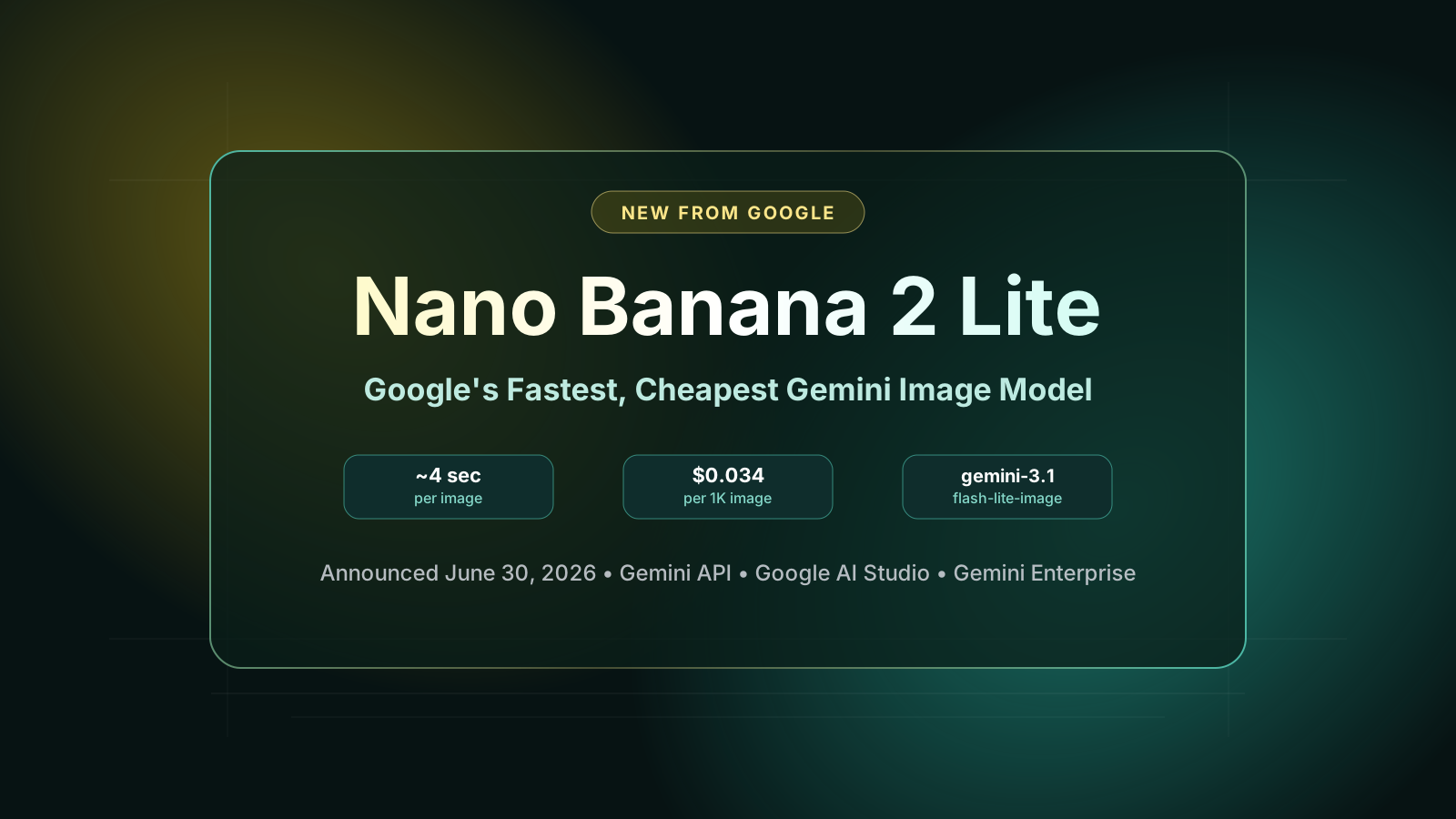
On June 30, 2026, Google quietly reshuffled its image-generation lineup with Nano Banana 2 Lite — a stripped-down, speed-first sibling to Nano Banana 2 and Nano Banana Pro. Its pitch is simple: give developers and creators a model built for volume, not for the single perfect hero shot.
The headline numbers are hard to ignore. A text-to-image generation lands in about 4 seconds, priced at roughly $0.034 per 1K-resolution image — a fraction of what Nano Banana 2 or Pro cost at higher resolutions. Google shipped it alongside Gemini Omni Flash, a companion video model, so the same cheap image can be animated right after it's generated.
Update, July 1, 2026: Nano Banana 2 Lite is now live on HeyMarmot. You can generate new images or edit existing ones with up to 10 reference images and 15 aspect ratios. Each generation uses 40 HeyMarmot credits. Try Nano Banana 2 Lite now.
What You'll Learn
- What Nano Banana 2 Lite actually is and how it differs from the rest of the Nano Banana family
- Real pricing and speed numbers, not marketing rounding
- Where it's available — API, AI Studio, Enterprise, and consumer surfaces
- The trade-offs you take on for that speed and price
- What this means if you create images or video at scale
- How to use it now in the HeyMarmot workspace
The Headline: 4-Second Images at a Fraction of the Cost
Nano Banana 2 Lite is built around one idea — throughput over ceiling. Google describes it as the fastest and most cost-efficient model in the Nano Banana family, optimized for creators who need to "workshop images and produce a large number of them in quick succession" rather than chase maximum creative control on every single frame.
In practice that means:
- ~4 seconds per text-to-image generation
- ~$0.034 per 1K-resolution image
- 1K resolution only — no 2K or 4K output, unlike its bigger siblings
- API identifier
gemini-3.1-flash-lite-image, positioned as the direct replacement for the original (now legacy) Nano Banana /gemini-2.5-flash-image
For comparison, Nano Banana 2's standard tier runs roughly $0.151 per 4K image, and Nano Banana Pro around $0.24 per 4K image. Lite isn't a cheaper way to get the same output — it's a different tool for a different job.
Where It's Available
Google rolled Nano Banana 2 Lite out broadly on day one:
- Developers: Google AI Studio, the Gemini API, and the Gemini Enterprise Agent Platform
- Consumers: AI Mode in Search, the Gemini app, NotebookLM, Google Photos, Google Stitch, Google Flow, and Google Ads
- HeyMarmot creators: Available now in the image model selector for text-to-image generation and reference-based editing
That's a wider simultaneous rollout than most Gemini image model launches, which signals Google wants Lite to become the default for anything that doesn't need Pro-level fidelity.
How It Fits in the Nano Banana Family
| Nano Banana 2 Lite | Nano Banana 2 | Nano Banana Pro | |
|---|---|---|---|
| API name | gemini-3.1-flash-lite-image | gemini-3-pro-image family | gemini-3-pro-image (Pro tier) |
| Resolution | 1K only | 0.5K / 1K / 2K / 4K | 1K / 2K / 4K |
| Speed | ~4 seconds (fastest) | Balanced | More deliberate |
| Price (4K) | Not supported | ~$0.151 | ~$0.24 |
| Text-to-image Elo | 1251 | — | 1245 |
| Reference images | Fewer, simpler edits | Up to 14 | Up to 14 |
| Best for | High-volume batch generation, rapid iteration | General-purpose production | Complex final renders, brand-critical output |
The Elo number is the surprising bit: on Google's own text-to-image leaderboard, Lite edges out Pro (1251 vs 1245). That's not a contradiction — it reflects raw single-prompt image quality, not the deeper reasoning, multi-reference composition, and 4K fidelity that Pro is actually built for. Lite is tuned to be good enough, fast — not to out-think your prompt.
The Trade-offs
Speed and price this aggressive come with real limits:
- No 2K/4K output. If you need print-quality or large-format assets, Lite tops out below what Nano Banana 2 and Pro deliver.
- Less reasoning depth. Nano Banana 2 and Pro apply heavier multi-step reasoning to interpret complex prompts and multi-image references. Lite trades some of that for latency.
- Simpler editing. Complex compositing, style transfer, and multi-reference workflows are still Nano Banana 2 / Pro territory.
Think of Lite as the model you reach for when you're generating the twentieth variation, not the first.
The Companion Release: Gemini Omni Flash
Google didn't ship Nano Banana 2 Lite alone — it launched alongside Gemini Omni Flash, a fast, low-cost image-to-video model. Together they form a pipeline: generate a still cheaply with Lite, then animate it cheaply with Omni Flash. Google's framing is direct — building generative media is "often about creative iteration," and this pairing is meant to make high-volume, end-to-end multimedia production practical at a price point that didn't really exist before.
What This Means for Creators
- Batch and catalog work — product variations, thumbnail sets, and ad creative at scale finally have a purpose-built, affordable model
- Rapid prototyping — rough out a composition or concept in seconds before committing a final pass to Nano Banana Pro
- Image-to-video pipelines — pair Lite with Omni Flash to go from prompt to cheap animated clip in one workflow
- Cost-sensitive, high-frequency apps — anything generating images programmatically at scale (search results, ad platforms, chat assistants) gets a meaningfully cheaper default
The bigger signal here is that Google is explicitly segmenting its image lineup by job, not just by quality tier: Lite for volume, Nano Banana 2 for general production, Pro for the shots that need to be right. That's a more mature product strategy than "one model, three sizes" — and it's likely the shape more AI image providers converge on next.
How to Use Nano Banana 2 Lite on HeyMarmot
Nano Banana 2 Lite is available now in the HeyMarmot workspace. To create with it:
- Open the workspace and switch to image generation.
- Select Nano Banana 2 Lite from the model menu.
- Enter your prompt and optionally upload up to 10 reference images.
- Choose one of the 15 supported aspect ratios, including square, portrait, landscape, and ultra-wide formats.
- Generate your image. Each generation uses 40 HeyMarmot credits.
Use it for fast concept exploration, ad variations, product mockups, thumbnails, or lightweight image edits. When you need 2K or 4K output and deeper reasoning, switch to Nano Banana 2 or Nano Banana Pro in the same workspace.
Conclusion
Nano Banana 2 Lite isn't trying to be the best image model Google has ever shipped — it's trying to be the cheapest, fastest one that's still good enough to use in production. At 4 seconds and $0.034 per image, it opens up workflows that were previously too slow or too expensive to run at scale.
Nano Banana 2 Lite is now available alongside Nano Banana 2 and Nano Banana Pro in the HeyMarmot workspace. Choose Lite when speed and iteration volume matter most, then move to the larger models when your final image needs more resolution or creative control.